
Design Guide Meets DCP
The North-West Urban Release Area (NWURA) Residential Development Control Plan came into effect late last year, marking an important step for medium density development in Dubbo’s future. The DCP guides residential development in a new greenfield precinct close to the city centre, identified as a key area to accommodate population increases and deliver greater housing diversity in Dubbo’s regional context. We’re excited to see the plan now in force and shaping outcomes on the ground - take a look here.
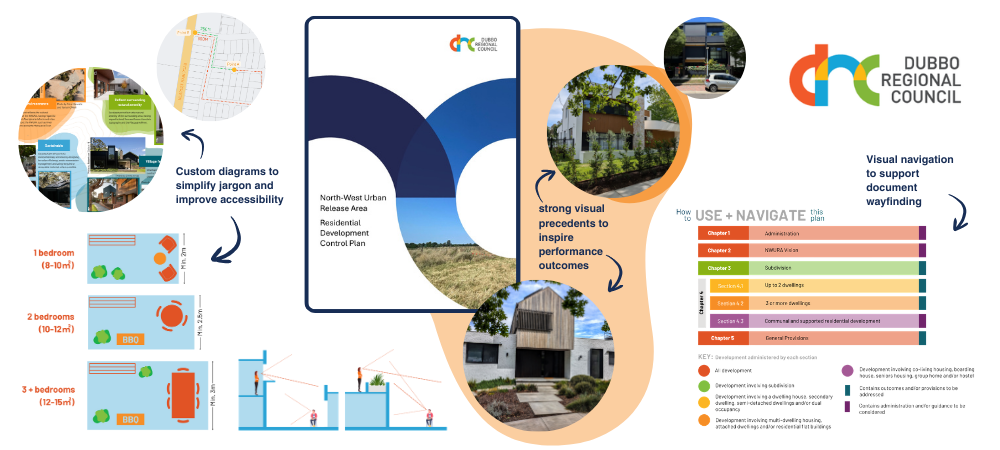
Purdon worked in collaboration with Delos Delta and Dubbo Regional Council, with engineering input from Premise, to prepare the plan. The brief was to translate an ambitious masterplan vision into a practical statutory planning document. In reality, this meant responding to a number of local challenges.
Planning with local conditions front of mind
Early project discussions highlighted three key issues. First, Dubbo has a relatively limited supply of medium density housing, with strong community preferences for detached homes. Where medium density does exist, it is often associated with older social housing examples, reinforcing stigma around these typologies.
Second, many development applications in the region are prepared by project builders or everyday applicants rather than specialist consultants. Any new planning framework would need to be intuitive, practical, and easy to navigate.
Third, Council sought a balance between prescriptive controls and performance-based outcomes. The DCP needed to provide certainty, while still supporting the masterplan’s aspirations for a more sustainable, diverse and walkable precinct.
Reimagining the role of a DCP
The resulting document takes a deliberately visual approach. Rather than relying solely on technical language, it operates as a hybrid between a traditional DCP and a medium density design guide. Clear planning provisions are supported by diagrams and carefully curated photographs, grouped into three categories:
Explanatory guidance that translates complex provisions into clear visual concepts
Encouraged outcomes, showing both innovative and conventional examples of quality medium density housing in relatable regional contexts
Discouraged outcomes, illustrating the cumulative impacts of poor design decisions
This structure allows the plan to retain the clarity of a typical DCP, while also striving to inspire and guide better outcomes.
Ensuring local resonance
A key principle was ensuring the plan felt locally relevant. Rather than using international precedents or examples from very different climates and contexts, the visuals were drawn from places that could reasonably resonate with Dubbo’s setting, while still presenting more diverse and design-led housing typologies.
This approach helps the DCP speak directly to its audience. It demonstrates how medium density housing can be attractive, practical, and compatible with Dubbo’s identity, while still lifting expectations around design and livability.
Planning as a tool for cultural change
By combining technical rigour with a visual approach, the NWURA Residential DCP shows how statutory planning tools can go beyond driving compliance - to inspire, shape perception surrounding intended outcomes and build planning literacy.
The result is a benchmark for how regional planning frameworks can support housing diversity and sustainable growth without losing touch with local character and community expectations.
If you’re exploring similar strategic planning or design-led policy projects, we’d love to hear from you.